
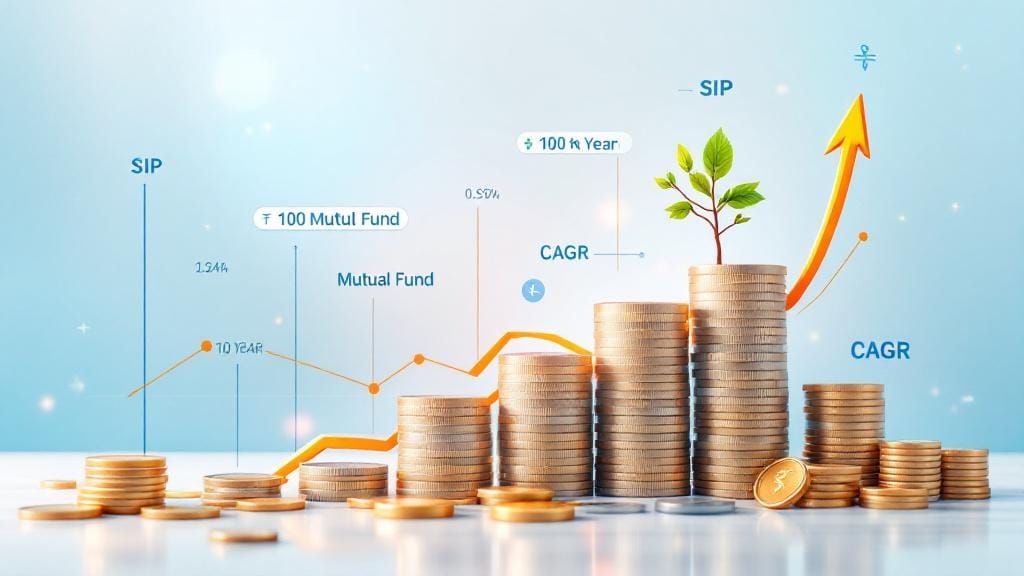
If you’re serious about building wealth, mutual fund returns over 10 years is one metric you simply cannot ignore. Long-term performance tells you more about a fund’s consistency, risk, and overall value than any one-year or three-year return can. Whether you’re a new investor or a seasoned wealth builder, understanding how mutual funds perform over a decade is key to smart investing.
In this guide, we’ll break down 10-year performance of mutual funds, help you analyze trends, compare returns, and uncover strategies to make informed decisions. Let’s dive in.
📈 Why 10-Year Mutual Fund Returns Matter
Investing is a marathon, not a sprint. While short-term returns can fluctuate due to market volatility, mutual fund growth over 10 years offers a clearer picture of a fund’s ability to withstand market cycles and still generate wealth.
Key Reasons to Focus on Long-Term Returns:
- Compounding Effect: Over a decade, small annual gains snowball into significant wealth thanks to compound interest.
- Consistency Over Hype: Many funds shine in 1–3 year windows but fade long-term. A consistent mutual fund return over 10 years signals reliability.
- Risk Adjustment: A long-term view accounts for both bull and bear markets, showing how a fund performs under different market conditions.
🏆 Top Performing Mutual Funds (10-Year Returns)
Let’s look at some of the top performing mutual funds over 10 years in India as of 2025 (based on historical data up to March 2025). These funds have delivered strong compound annual growth rate (CAGR) consistently.
| Fund Name | Category | 10-Year CAGR | Fund Type |
|---|---|---|---|
| Axis Long Term Equity Fund | ELSS | 15.8% | Equity |
| Mirae Asset Large Cap Fund | Large Cap | 14.9% | Equity |
| Kotak Emerging Equity Fund | Mid Cap | 18.3% | Equity |
| Parag Parikh Flexi Cap Fund | Flexi Cap | 17.6% | Equity |
| SBI Small Cap Fund | Small Cap | 19.2% | Equity |
Note: Past performance does not guarantee future results. Always check recent performance, fund manager continuity, and portfolio composition.
🧮 Understanding Mutual Fund CAGR Over 10 Years
CAGR (Compound Annual Growth Rate) is the gold standard for measuring mutual fund returns over 10 years. It tells you the average yearly return assuming the growth is compounded.
CAGR Formula:
plaintextCopyEditCAGR = [(Ending Value / Beginning Value) ^ (1 / Number of Years)] - 1
Example: If you invested ₹1,00,000 in a fund and it grew to ₹4,00,000 in 10 years:
- CAGR = [(400000 / 100000) ^ (1/10)] – 1 = 14.87%
This means your money grew at 14.87% every year for a decade.
💰 SIP Returns Over 10 Years: A Smarter Strategy?
A Systematic Investment Plan (SIP) is a popular way to invest in mutual funds monthly. It helps in rupee cost averaging, which reduces risk over time.
SIP Example:
If you invested ₹5,000 per month for 10 years in a fund with 14% CAGR:
- Total Investment: ₹6,00,000
- Approx Value: ₹11.60 lakh
SIP returns over 10 years are highly attractive because they lower volatility and suit salaried investors.
🧠 Long-Term Investment Strategies for Mutual Funds
Investing with a 10-year horizon requires discipline and the right approach. Here are key strategies:
✅ Diversify Across Fund Types
Include large cap, mid cap, small cap, and debt funds to balance risk and reward.
✅ Stick With Consistent Performers
Focus on funds that show consistent mutual fund returns over 10 years, not just short-term spikes.
✅ Don’t Chase High Returns Blindly
High returns often come with high volatility. Evaluate risk-adjusted return metrics like Sharpe Ratio.
✅ Compare With Benchmarks
Always compare a fund’s performance with its benchmark index over 10 years.
📊 Comparing SIP vs Lump Sum Over 10 Years
| Feature | SIP | Lump Sum |
|---|---|---|
| Best For | Monthly Income Investors | One-time windfall investments |
| Volatility | Low | High |
| Flexibility | High | Low |
| Rupee Cost Averaging | Yes | No |
Conclusion: SIP wins in most cases due to its ability to average costs and manage volatility.
📉 Volatility in Long-Term Mutual Funds
Even over 10 years, equity mutual fund 10 year performance can show ups and downs. That’s why patience is key.
Real Example:
During COVID-19 (2020), many mutual funds fell sharply. But those who stayed invested saw returns bounce back in 2021–2022, proving the power of long-term investing.
🔍 Risk-Adjusted Metrics to Evaluate Funds
Don’t just look at CAGR. Also analyze:
- Sharpe Ratio: Return per unit of risk
- Standard Deviation: Measures volatility
- Alpha: Performance over benchmark
- Beta: Sensitivity to market moves
These tools help you pick top performing mutual funds for 10 years with lower risk.
📈 NAV Trends Over 10 Years
A mutual fund’s Net Asset Value (NAV) shows how the fund’s unit price changes over time. Monitoring NAV trends over 10 years helps assess fund health.
Tip: Use NAV charts from fund houses or tools like Value Research and Morningstar for trend analysis.
🤔 Past Returns vs Future Performance: Should You Rely on It?
While historical performance of mutual funds gives insights, it’s not a crystal ball.
What to Do Instead:
- Use it as one part of your decision-making
- Consider current portfolio allocation and fund manager strategy
- Focus on long term mutual fund returns, not just past glories
📚 Real-Life Investor Example
Name: Arjun, Age 35
Goal: Save ₹50 lakhs for retirement in 20 years
Plan: SIP ₹10,000/month in 3 funds with average CAGR of 13%
Result in 10 Years: Approx ₹23 lakhs (on ₹12 lakh invested)
Lesson: Even modest monthly SIPs can build wealth with time.
📌 Final Thoughts: Are 10-Year Returns the Right Metric?
Absolutely. Mutual fund returns over 10 years help you:
- Identify consistent performers
- Beat inflation
- Plan for long-term goals like retirement or children’s education
But remember — past returns are one tool, not the only tool. Match performance with your risk profile, time horizon, and goals.
❓FAQs About Mutual Fund Returns Over 10 Years
1. What is a good mutual fund return over 10 years?
A good return depends on the fund type, but for equity mutual funds, a CAGR between 12–15% over 10 years is considered strong.
2. Which mutual fund has the best return in the last 10 years?
Funds like SBI Small Cap Fund, Kotak Emerging Equity, and Parag Parikh Flexi Cap have shown top performing mutual fund returns in 10 years.
3. Is it better to invest via SIP or lump sum for 10 years?
SIP is safer for most investors as it averages the cost and reduces volatility, especially in long-term investment strategies.
4. Can I expect the same future return as the past 10 years?
Not necessarily. Use past returns vs future performance comparisons carefully, and analyze current market trends and fund strategy.
5. How to track mutual fund CAGR for 10 years?
You can use platforms like Morningstar, Value Research Online, or the AMC’s website to check mutual fund CAGR for 10 years.
6. Do large cap funds offer consistent 10-year returns?
Yes, many large cap mutual funds 10 year return range between 12–14%, offering relative stability with decent growth.
7. What is the difference between trailing returns and CAGR?
Trailing returns reflect the return from a specific past date, while CAGR averages annual returns, smoothing out volatility for a better long-term view.
✅ Summary
Mutual fund returns over 10 years serve as a lighthouse for investors sailing the volatile sea of markets. They reveal the real performers — funds that stayed strong through booms and crashes. Use this knowledge to build a resilient, long-term portfolio that aligns with your goals.






Comments (0)