
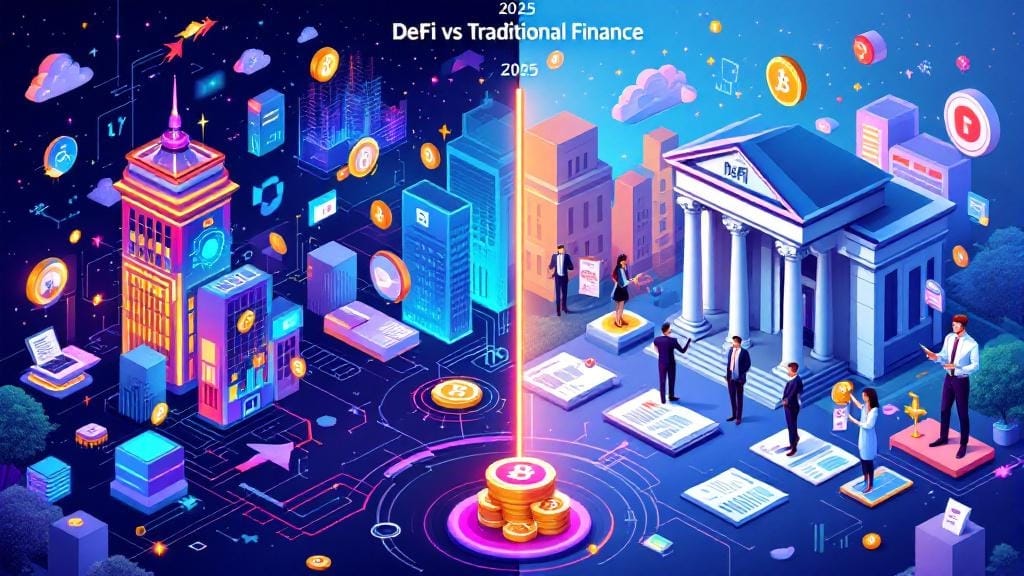
In the world of finance, 2025 feels like standing at a fork in the road. One path leads to the age-old institutions we’ve always known—banks, insurance companies, and government-backed lending. The other? A revolutionary world of code, crypto, and control in your own hands: DeFi, or decentralized finance.
So, which one is better for the future? And more importantly, which one is better for you?
This complete guide to DeFi vs traditional finance will help you understand the differences, the advantages and disadvantages of each, and what the future of money might look like.
What is DeFi (Decentralized Finance)?
Decentralized finance, or DeFi, is a blockchain-based alternative to traditional financial systems. Unlike traditional finance, which relies on centralized institutions, DeFi runs on smart contracts, decentralized exchanges, and blockchain technology.
DeFi allows anyone with an internet connection to:
-
Lend or borrow crypto without a bank
-
Trade assets on decentralized exchanges (DEXs)
-
Earn passive income through yield farming or liquidity pools
-
Participate in decentralized insurance, investing, and savings protocols
It’s borderless, open-source, and—perhaps most importantly—permissionless.
What is Traditional Finance?
Traditional finance (TradFi) refers to the established financial system we’ve used for centuries. This includes:
-
Banks
-
Credit unions
-
Stock markets
-
Insurance firms
-
Central banks and regulators
Traditional finance works through financial intermediaries—middlemen like banks and brokers who hold custody of your money, process transactions, and enforce rules.
It’s heavily regulated, slower-moving, and considered more stable and secure—but often less inclusive and more costly for users.
Key Differences: DeFi vs Traditional Finance
Let’s break down the decentralized finance vs traditional finance debate by comparing them across essential features.
1. Control and Custody
-
Traditional Finance: Institutions hold your money and make decisions on your behalf.
-
DeFi: You control your assets. No bank, no gatekeeper—just your wallet and a smart contract.
2. Access and Inclusivity
-
Traditional Banking Systems: Require KYC (Know Your Customer), proof of identity, and often exclude the unbanked.
-
DeFi Platforms: Open to anyone, anywhere. All you need is a crypto wallet and internet.
3. Transparency
-
TradFi: Operates behind closed doors. You rarely see how decisions are made.
-
DeFi: Code is open-source. All transactions are public on the blockchain.
4. Fees and Costs
-
Traditional Financial Services: Charge fees for almost everything—account maintenance, wire transfers, loan interest, etc.
-
DeFi: Minimal fees. Smart contracts automate everything, cutting out the middleman.
5. Innovation Speed
-
Traditional Finance: Slow, often years behind in adopting new technology.
-
DeFi: Lightning-fast innovation cycles. New protocols launch almost daily.
DeFi Advantages Over Traditional Finance
Here’s why many are turning to DeFi as a better alternative to traditional finance in 2025:
✅ Lower Fees
No banks, no brokers—just automated smart contracts and minimal gas fees.
✅ Accessibility
With over 1.7 billion unbanked adults globally, DeFi offers access to anyone with a phone and internet.
✅ Passive Income Opportunities
Yield farming, staking, and liquidity mining offer new ways to grow your crypto.
✅ Global and Borderless
No currency conversions, no national boundaries. DeFi is truly global.
✅ Rapid Innovation
With protocols like Aave, Compound, Uniswap, and Curve, DeFi is constantly evolving.
Where Traditional Finance Still Wins
Let’s be real—traditional finance isn’t going away overnight. It still has strengths that DeFi hasn’t fully matched (yet):
🔒 Regulation and Security
Licensed institutions offer protections (like deposit insurance) and legal recourse.
👥 Human Support
Got a problem with your transaction? In TradFi, you can call someone. In DeFi, not so much.
🧩 Integration with the Economy
Payrolls, mortgages, taxes—all still run through banks. DeFi hasn’t fully integrated yet.
Real-Life Example: Lending Money
-
In traditional finance, you go to a bank, apply for a loan, wait days (or weeks), and pay interest to the bank.
-
In DeFi, you can lend or borrow instantly using smart contracts, sometimes even anonymously.
Platforms like Aave and Compound allow peer-to-peer lending using crypto as collateral—without ever involving a bank.
DeFi Adoption in Traditional Finance
Interestingly, banks and institutions are beginning to adopt DeFi concepts.
-
JPMorgan has explored tokenization of assets and blockchain-based settlements.
-
BlackRock and Fidelity are experimenting with crypto ETFs and DeFi exposure.
-
Governments are piloting CBDCs (Central Bank Digital Currencies) using blockchain.
This blending of DeFi and TradFi could reshape the financial world entirely.
Traditional Finance vs Blockchain Technology
Blockchain offers transparency, immutability, and decentralization—something traditional finance lacks. As more people understand this, traditional finance vs blockchain isn’t just a debate; it’s a transformation in progress.
Expect to see hybrid financial models, where banks use blockchain for back-end operations while maintaining customer-facing interfaces.
The Future: Traditional Finance Alternatives
As DeFi grows, we’re seeing credible alternatives to everything TradFi offers:
| Traditional Service | DeFi Alternative |
|---|---|
| Savings Account | Crypto staking/yield farming |
| Loans | Crypto-backed loans |
| Stock Market | Tokenized assets, DeFi ETFs |
| Exchanges | Decentralized exchanges (DEXs) |
| Insurance | Peer-to-peer insurance protocols |
| Remittance | Cross-border crypto transfers |
FAQs – Answering Common Questions About DeFi vs Traditional Finance
1. Is DeFi safer than traditional finance?
While DeFi removes third-party risks, it introduces smart contract and hacking risks. TradFi has more legal protections. So, both have their trade-offs.
2. Can DeFi replace traditional banking completely?
Not yet. DeFi is growing fast but still lacks the regulation, infrastructure, and mainstream adoption of traditional banks. A hybrid future is more likely.
3. What are examples of DeFi platforms?
Popular DeFi platforms include Uniswap, Aave, Compound, Curve, and MakerDAO. Each serves unique roles like lending, trading, or stablecoins.
4. How does smart contracts in finance work?
Smart contracts are self-executing programs on the blockchain. In DeFi, they handle lending, trading, and payments automatically—no human needed.
5. How is DeFi changing the cryptocurrency market?
DeFi expands crypto use cases beyond speculation. Now, users can lend, borrow, and earn—turning crypto into functional financial tools.
6. What is peer-to-peer lending in DeFi?
It’s when users lend directly to others using crypto, with no bank involved. Platforms like Aave or Compound facilitate this using smart contracts.
7. What are liquidity pools in DeFi?
Liquidity pools are collections of tokens locked in smart contracts. They power DEXs by allowing users to trade assets without traditional market makers.






Comments (0)