
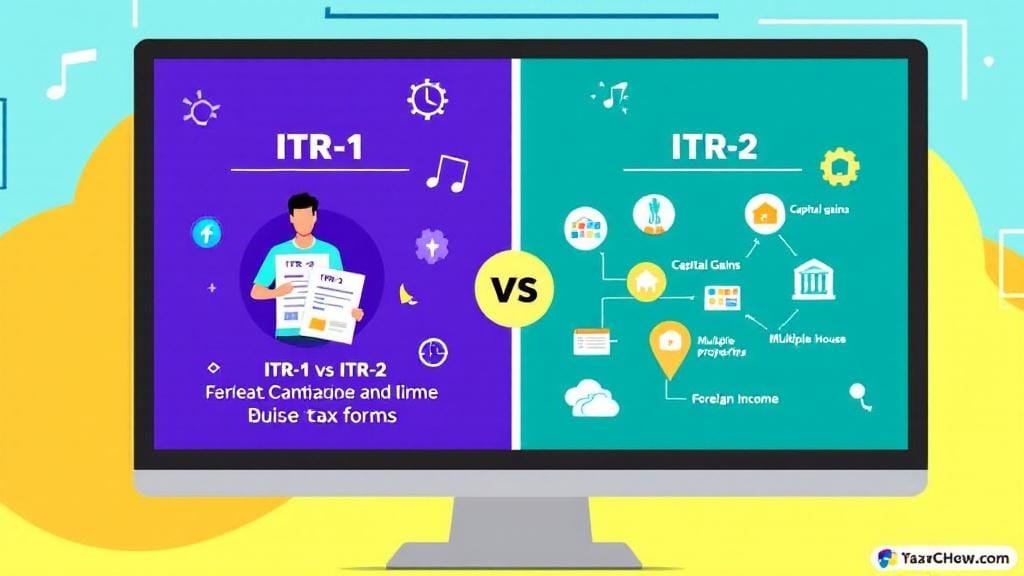
Filing your income tax return (ITR) is a necessary and often stressful task for many taxpayers in India. With different types of ITR forms available, it can be confusing to know which one to use, especially when deciding between ITR-1 vs ITR-2. Understanding the difference between these two forms is crucial to ensure you’re complying with tax regulations and minimizing the chances of errors or delays in your filing process.
In this detailed ITR filing guide, we’ll break down the ITR-1 vs ITR-2 debate, helping you understand the eligibility criteria for each form, the differences between them, and which form you should choose based on your financial situation.
Table of Contents
What Are ITR-1 and ITR-2 Forms?
ITR-1 (also known as Sahaj) and ITR-2 are two of the most commonly used forms for filing Income Tax Returns in India. Each form is designed for specific taxpayers based on their income sources, and selecting the correct form is crucial to avoid penalties or complications.
ITR-1: The Simple and Easy Form
ITR-1 is the most straightforward tax return form, designed for individuals who have simple income sources. It’s primarily for salaried individuals, pensioners, and people who earn income from one house property or other sources like interest income. If your financial situation is straightforward, ITR-1 is usually the ideal choice.
ITR-2: The More Comprehensive Form
On the other hand, ITR-2 is a more comprehensive form used by individuals with more complex financial situations. If you have income from capital gains, multiple house properties, or business or professional income (without claiming profits and gains under section 44AD, 44ADA, or 44AE), ITR-2 is your go-to form. It’s also used by people who have income from foreign sources or foreign assets.
Eligibility Criteria: Who Can File ITR-1 and ITR-2?
ITR-1 Eligibility Criteria
To be eligible for ITR-1, your income should meet the following criteria:
-
You must be a resident (not a non-resident or resident but not ordinarily resident).
-
Income from Salary/Pension: You earn a salary, pension, or income from one house property.
-
Income from Other Sources: You have income from interest, family pension, or lottery.
-
The total income does not exceed ₹50 lakh in the financial year.
-
No Capital Gains: You don’t have any income from capital gains or losses.
-
No Foreign Income: You do not have any foreign income or foreign assets.
Example: A salaried employee who earns a salary of ₹12 lakh annually and has no other sources of income or capital gains will file ITR-1.
ITR-2 Eligibility Criteria
You need to file ITR-2 if:
-
Your total income exceeds ₹50 lakh in a financial year.
-
You have income from capital gains, whether short-term or long-term.
-
You have income from more than one house property.
-
You have foreign income or foreign assets.
-
Your income includes profits from a business or profession, but you are not opting for presumptive taxation schemes (section 44AD, 44ADA, or 44AE).
-
You are claiming deductions under sections 80C to 80U (such as for life insurance premiums, PPF, etc.).
Example: A person with a ₹15 lakh salary, ₹5 lakh from long-term capital gains, and ₹2 lakh from one house property would file ITR-2.
Difference Between ITR-1 and ITR-2
While both ITR-1 and ITR-2 are used for individual taxpayers, there are clear distinctions between them. Let’s dive into the key differences:
Income Sources
-
ITR-1 is for taxpayers with income from salary, one house property, and other sources like interest income.
-
ITR-2 is for individuals with more complex income sources, such as capital gains, multiple house properties, or foreign income.
Total Income Limit
-
ITR-1 is only available to individuals whose total income is below ₹50 lakh.
-
ITR-2 can be filed by individuals with any income level, but it is commonly used for people with more significant or diverse income streams.
Complexity of Filing
-
ITR-1 is simpler and more straightforward, making it ideal for salaried individuals or pensioners with a single source of income.
-
ITR-2 is more complex, requiring detailed reporting of capital gains, multiple properties, and other income sources.
Additional Forms
-
ITR-1 does not require the filing of any additional forms.
-
ITR-2 may require additional forms such as Schedule CG (for capital gains) or Schedule FSI (for foreign income).
How to Choose Between ITR-1 and ITR-2
Choosing the right ITR form depends on your income profile. If you are confused about which form to file, here’s a simple guide:
-
Choose ITR-1 if:
-
You are a salaried employee or a pensioner.
-
You have income from one house property and no other sources of income.
-
You don’t have capital gains or any foreign income.
-
-
Choose ITR-2 if:
-
You have income from multiple house properties.
-
You have capital gains or losses.
-
You earn income from other sources, such as business profits, or have foreign income.
-
Quick Tip: If you are still unsure, consult a tax advisor. They can help ensure you’re selecting the correct form based on your specific circumstances.
ITR-1 vs ITR-2 for Salaried Individuals
Most salaried individuals will fall under the ITR-1 category. If your income comes from salary, a single house property, and other sources like interest, then ITR-1 is the ideal form for you.
However, if you are a salaried person and also have income from capital gains, multiple properties, or other more complex sources of income, you may need to file ITR-2. For example, if you sold a stock for a profit or have multiple rental properties, ITR-2 would be the correct choice.
ITR-1 vs ITR-2 for Individuals with Capital Gains
If you have capital gains—whether from the sale of stocks, mutual funds, or property—ITR-2 is the form you’ll need to file. ITR-1 does not accommodate capital gains, so filing ITR-1 in such cases would lead to incorrect filing.
For example, if you sold shares and earned long-term capital gains exceeding ₹1 lakh, you must file ITR-2 and disclose your gains in Schedule CG.
FAQs: Common Questions on ITR-1 vs ITR-2
1. Which income tax form should I file in India?
If your income is from salary and one house property, and your total income is less than ₹50 lakh, you should file ITR-1. If you have capital gains, income from multiple properties, or foreign income, file ITR-2.
2. Who should file ITR-1 and who should file ITR-2?
ITR-1 is for salaried individuals, pensioners, and those with limited income. ITR-2 is for people with more complex income sources like capital gains, multiple properties, or foreign income.
3. Can a salaried person file ITR-2 instead of ITR-1?
Yes, a salaried person can file ITR-2 if they have additional income from sources such as capital gains or multiple properties.
4. What is the difference between ITR-1 and ITR-2 for FY 2024-25?
For FY 2024-25, the basic differences between ITR-1 and ITR-2 remain the same. ITR-1 is for simple income from salary and one






Comments (0)