Blog
Best Credit Cards for Grocery Shopping in India: Cashback Compared

An Indian household spending ₹10,000 a month on groceries — across DMart, BigBasket, Blinkit, Zepto, or the neighbourhood kirana store — can recover between ₹1,200 and ₹14,400 annually by choosing the right credit card. The difference between cards is not the headline reward rate but the monthly cap, the merchant category code (MCC) classification, and whether your preferred grocery channel qualifies for the accelerated tier at all.
Why grocery spending deserves its own card strategy
Groceries are the single largest recurring household expense category after rent and EMIs. According to the National Statistical Office’s Household Consumer Expenditure Survey (2023–24), food and beverages account for roughly 39% of monthly urban household spending in India.
Unlike travel or dining — where spending is discretionary and lumpy — grocery purchases recur every week. A card that earns even 2% more on grocery transactions compounds into thousands of rupees over a year. Yet most cardholders default to a general-purpose cashback card without checking whether their supermarket or quick-commerce app triggers the accelerated reward tier.
The problem: not all “grocery” transactions are classified as grocery by your bank. A BigBasket order may carry a grocery MCC, while a Swiggy Instamart order may carry a food-delivery MCC. This distinction determines whether you earn 10% or 1%.
Four cards compared: grocery rewards head-to-head
We selected four widely available cards that offer accelerated rewards on grocery or supermarket spending. Each card has a different mechanism — some reward offline supermarkets, others reward quick-commerce apps, and one rewards both.
| Dimension | SBI SimplySAVE | HSBC Live+ | HDFC Millennia | SBI Cashback |
|---|---|---|---|---|
| Annual Fee | ₹499 + GST | ₹999 + GST | ₹1,000 + GST | ₹999 + GST |
| Fee Waiver Spend | ₹1,00,000 / year | ₹2,00,000 / year | ₹1,00,000 / year | ₹2,00,000 / year |
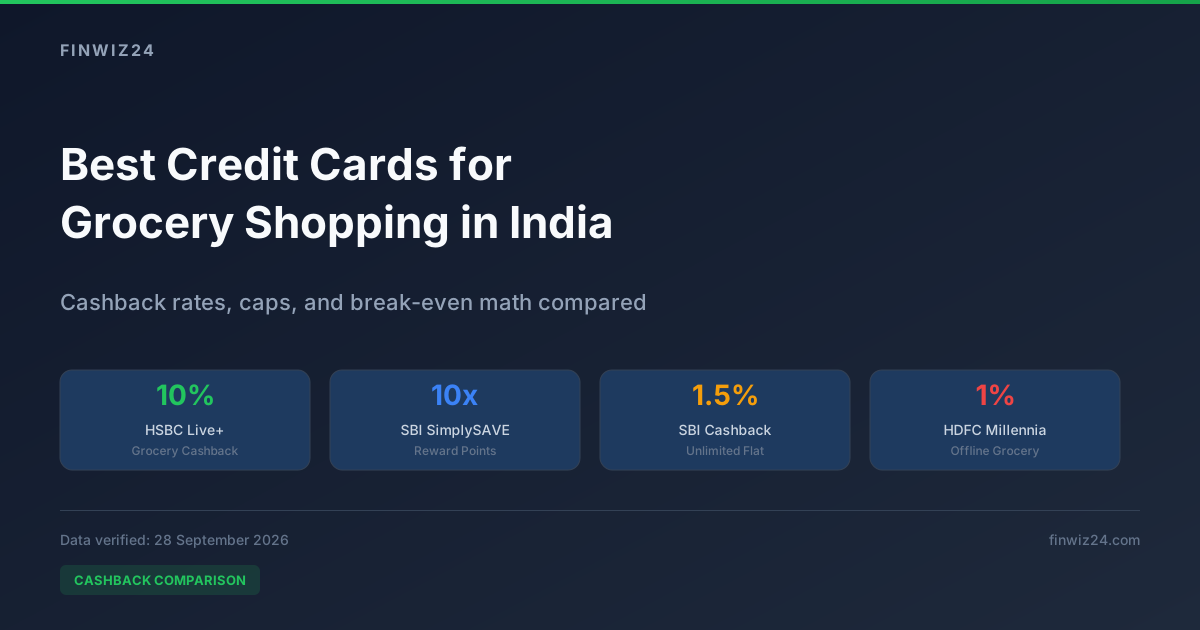
| Grocery Reward Rate | 10x points (~1.67%) | 10% cashback | 1% (5% via Amazon Fresh) | 1.5% cashback |
| Grocery Reward Type | Reward points (4 RP = ₹1) | Direct statement credit | CashPoints (1 CP = ₹1) | Direct statement credit |
| Qualifying Grocery Channels | Offline supermarkets, departmental stores (MCC-based) | Blinkit, Zepto, DMart, grocery-MCC merchants | Amazon Fresh (5%); offline stores (1%) | All retail (flat 1.5%) |
| Monthly Cap on Grocery | No explicit grocery cap (points system) | ₹1,200/cycle (shared across dining + grocery + shopping) | ₹1,000/month (5% partner cap) | Unlimited (1.5% flat) |
| Base Rate (Non-Grocery) | 1 RP per ₹150 (~0.17%) | 1.5% unlimited | 1% all other retail | 1.5% unlimited |
| Lounge Access | None | 4 domestic + 1 international / year | None | None |
| Forex Markup | 3.50% + GST | 1.99% + GST | 3.50% + GST | 3.50% + GST |
The math: annual grocery cashback across three household budgets
To determine the actual rupee returns, we model three monthly grocery budgets — ₹5,000 (single person or small household), ₹10,000 (typical urban family), and ₹20,000 (large family or bulk buyer) — assuming all spending qualifies for each card’s grocery tier.
Scenario 1: ₹5,000 monthly grocery spend
| Card | Monthly Grocery Cashback | Annual Grocery Cashback | Annual Fee (incl. GST) | Net Annual Value |
|---|---|---|---|---|
| SBI SimplySAVE (10x) | ~₹83 | ~₹1,000 | ₹589 | +₹411 |
| HSBC Live+ (10%) | ₹500 | ₹6,000 | ₹1,179 | +₹4,821 |
| HDFC Millennia (1%) | ₹50 | ₹600 | ₹1,180 | −₹580 |
| SBI Cashback (1.5%) | ₹75 | ₹900 | ₹1,179 | −₹279 |
At ₹5,000 monthly grocery spending, HSBC Live+ returns ₹4,821 net — nearly 12x the SBI SimplySAVE return. HDFC Millennia and SBI Cashback fail to recover their annual fees from grocery spending alone.
Scenario 2: ₹10,000 monthly grocery spend
| Card | Monthly Grocery Cashback | Annual Grocery Cashback | Annual Fee (incl. GST) | Net Annual Value |
|---|---|---|---|---|
| SBI SimplySAVE (10x) | ~₹167 | ~₹2,000 | ₹589 | +₹1,411 |
| HSBC Live+ (10%) | ₹1,000 (capped at ₹1,200 shared) | ₹12,000 (cap-adjusted ~₹10,800) | ₹1,179 | +₹9,621 |
| HDFC Millennia (1%) | ₹100 | ₹1,200 | ₹1,180 | +₹20 |
| SBI Cashback (1.5%) | ₹150 | ₹1,800 | ₹1,179 | +₹621 |
At ₹10,000 monthly spending, the HSBC Live+ cap becomes relevant — the ₹1,200 monthly shared cap across dining, grocery, and shopping means heavy grocery spenders who also dine out may hit the ceiling. Even so, HSBC Live+ delivers ₹9,621 in net annual value — the clear winner.
Scenario 3: ₹20,000 monthly grocery spend
| Card | Monthly Grocery Cashback | Annual Grocery Cashback | Annual Fee (incl. GST) | Net Annual Value |
|---|---|---|---|---|
| SBI SimplySAVE (10x) | ~₹333 | ~₹4,000 | Waived (spend > ₹1L) | +₹4,000 |
| HSBC Live+ (10%) | ₹1,200 (cap hit) | ₹14,400 (cap-adjusted ~₹12,000) | Waived (spend > ₹2L) | +₹12,000 |
| HDFC Millennia (1%) | ₹200 | ₹2,400 | Waived (spend > ₹1L) | +₹2,400 |
| SBI Cashback (1.5%) | ₹300 | ₹3,600 | Waived (spend > ₹2L) | +₹3,600 |
At ₹20,000 monthly, the annual fee is waived for all four cards. HSBC Live+ still leads at ₹12,000 net, but the cap erodes the effective rate to ~5% instead of the headline 10%. SBI SimplySAVE’s uncapped 10x structure now delivers ₹4,000 — competitive for those who prefer SBI’s banking ecosystem.
Model your own grocery spending scenario using our reward calculator or annual-fee break-even calculator.
Break-even analysis: minimum grocery spend to recover annual fees
For each card, the minimum monthly grocery spending needed to recover the annual fee (including 18% GST) from grocery cashback alone:
SBI SimplySAVE: ₹589 ÷ 1.67% = ₹35,269 per year (or ₹2,939 per month)
HSBC Live+: ₹1,179 ÷ 10% = ₹11,790 per year (or ₹983 per month)
HDFC Millennia: ₹1,180 ÷ 1% = ₹1,18,000 per year (or ₹9,833 per month)
SBI Cashback: ₹1,179 ÷ 1.5% = ₹78,600 per year (or ₹6,550 per month)
HSBC Live+ breaks even at under ₹1,000 per month of grocery spending — most Indian households cross that threshold in a single weekly supermarket trip. HDFC Millennia, with only 1% on offline groceries, requires nearly ₹10,000 monthly to break even — making it a poor grocery-first card.
The MCC trap: why your grocery order may earn base rate
Merchant Category Codes (MCCs) determine which reward tier applies to a transaction. Indian banks do not publish their full MCC mapping, but the general classification follows the Visa/Mastercard global standard:
- MCC 5411 (Grocery Stores, Supermarkets): DMart, Reliance Fresh, Spencer’s, Star Bazaar, More Megastore, neighbourhood kiranas with a POS terminal
- MCC 5499 (Misc Food Stores): Some specialty food stores, organic markets
- MCC 5912 (Drug Stores, Pharmacies): Stores selling food alongside medicines (Apollo Pharmacy with grocery section)
- MCC 5814 (Fast Food): Swiggy Instamart, some quick-commerce apps
The critical distinction: Blinkit and Zepto typically carry MCC 5411 (grocery), making them eligible for grocery-tier cashback on HSBC Live+. Swiggy Instamart often carries MCC 5814 (fast food/restaurant), which falls under the dining tier instead. Amazon Fresh orders processed through Amazon carry Amazon’s e-commerce MCC, not grocery.
This means the same ₹2,000 grocery order earns different cashback depending on where you place it:
| Platform | Typical MCC | HSBC Live+ Rate | SBI SimplySAVE Rate |
|---|---|---|---|
| DMart (offline) | 5411 (Grocery) | 10% | 10x (~1.67%) |
| BigBasket | 5411 (Grocery) | 10% | 10x (~1.67%) |
| Blinkit | 5411 (Grocery) | 10% | 10x (~1.67%) |
| Zepto | 5411 (Grocery) | 10% | 10x (~1.67%) |
| Swiggy Instamart | 5814 (Fast Food) | 10% (dining tier) | Base 0.17% |
| Amazon Fresh | 5311/5399 (E-commerce) | 1.5% (base) | Base 0.17% |
Read our detailed explainer on how MCC codes affect your credit card rewards for the full classification list.
Winner by use case
HSBC Live+ is best for households buying groceries on Blinkit, Zepto, BigBasket, or DMart — the 10% rate with direct statement credit delivers the highest absolute returns under the ₹1,200 monthly cap.
SBI SimplySAVE is best for budget-conscious families who shop at offline supermarkets (DMart, Reliance Fresh, Spencer’s) and want the lowest annual fee (₹499) with a grocery-specific accelerated tier.
SBI Cashback is best for mixed spenders who want a single flat-rate card (1.5% unlimited) without worrying about MCC classifications, caps, or category restrictions.
HDFC Millennia is best only if you already buy groceries exclusively through Amazon Fresh (5% via Amazon partner rate) — otherwise, the 1% offline grocery rate makes it uncompetitive for supermarket spending.
Practical tips to maximize grocery cashback
-
Check your MCC before committing. After your first grocery transaction on a new card, review the statement to confirm the merchant was classified under MCC 5411. If it shows a different code, your accelerated cashback will not apply.
-
Separate grocery from dining in quick-commerce. Ordering groceries on Blinkit earns grocery-tier cashback, but ordering prepared food from the same platform may carry a different MCC. Keep grocery-only and food-delivery orders on different cards if your card distinguishes the two.
-
Time large purchases around billing cycles. If your card has a per-cycle cap (like HSBC Live+’s ₹1,200), split large monthly stock-up purchases across two billing cycles to stay under the cap each time.
-
Stack with platform discounts. Credit card cashback stacks with BigBasket Smart Saver discounts, DMart Ready promotions, and Blinkit coupon codes. The card cashback is calculated on the post-discount transaction amount.
-
Track your cap utilization. If you use HSBC Live+ for both dining and groceries, the ₹1,200 shared cap means a ₹800 Zomato order in the same cycle leaves only ₹400 of cap for grocery cashback. Allocate wisely or use a second card for dining.
Explore our full comparison tool to stack these cards against your other spending categories.
Frequently asked questions
Which credit card gives the highest cashback on grocery shopping in India?
The HSBC Live+ Credit Card offers 10% cashback on grocery purchases — the highest available rate among widely accessible Indian credit cards. This applies to transactions at merchants classified under MCC 5411 (Grocery Stores, Supermarkets), including platforms like Blinkit, Zepto, BigBasket, and offline supermarkets such as DMart. The cashback is capped at ₹1,200 per statement cycle, shared across dining, grocery, and shopping categories.
Does SBI SimplySAVE earn bonus rewards on BigBasket and Blinkit?
The SBI SimplySAVE Credit Card earns 10x reward points on grocery and departmental store transactions based on MCC classification. BigBasket and most physical supermarkets qualify under MCC 5411. Online quick-commerce platforms (Blinkit, Zepto) also generally qualify, but verification against your card statement is recommended because SBI bases its categorization on the acquiring bank’s MCC assignment.
Do grocery orders on Swiggy Instamart earn grocery cashback?
Not always. Swiggy Instamart orders often carry MCC 5814 (Fast Food Restaurants) rather than MCC 5411 (Grocery Stores). Cards that offer accelerated grocery rewards — like SBI SimplySAVE’s 10x tier — may classify Swiggy Instamart under dining or food delivery instead. Check your card statement after the first transaction to verify the MCC classification before relying on the grocery tier.
Is the HDFC Millennia a good card for grocery shopping?
The HDFC Millennia earns only 1% CashPoints on offline grocery purchases, which is below the market average for grocery-focused cards. Its 5% rate applies only to specific partners (Amazon, Flipkart, Swiggy, Zomato), so grocery spending through Amazon Fresh qualifies at 5%, but DMart, BigBasket, and other supermarkets earn the base 1%. For dedicated grocery spending, SBI SimplySAVE or HSBC Live+ offer materially better returns.
How much can I save annually using a grocery credit card?
On ₹10,000 monthly grocery spending, the HSBC Live+ returns approximately ₹10,800 annually at 10% (after accounting for the ₹1,200 shared monthly cap). After deducting the ₹1,179 annual fee (₹999 + GST), the net saving is approximately ₹9,621 per year. The SBI SimplySAVE returns approximately ₹2,000 annually at its 10x rate. Use our reward calculator to model your specific monthly spending pattern.
Sources
- SBI Card — SimplySAVE Credit Card features and schedule of charges (verified 28 September 2026).
- HSBC India — Live+ Credit Card features and reward terms (verified 28 September 2026).
- HDFC Bank — Millennia Credit Card reward structure (verified 28 September 2026).
- SBI Card — Cashback SBI Card features and schedule of charges (verified 28 September 2026).
- Reserve Bank of India — Master Direction on Credit Card and Debit Card Issuance and Conduct Directions (verified 28 September 2026).
- Visa Inc. — Merchant Category Code reference (verified 28 September 2026).
Related reading
- SBI SimplySAVE Credit Card — full fee schedule, reward tiers, and eligibility details
- HSBC Live+ Credit Card: Is the ₹999 Annual Fee Worth It? — detailed break-even analysis for dining and grocery spending
- Best Cashback Credit Cards in India 2026 — broader cashback comparison across all spending categories
- Understanding MCC Codes and How They Affect Your Rewards — why the same purchase earns different rewards on different cards
- Hidden Caps on Credit Card Rewards in India — how monthly capping structures reduce your effective cashback rate
- What Banks Quietly Exclude from Card Spend — the MCC exclusions that earn zero rewards