Blog
How to Close a Credit Card in India: The Right Way Without Hurting Your CIBIL Score

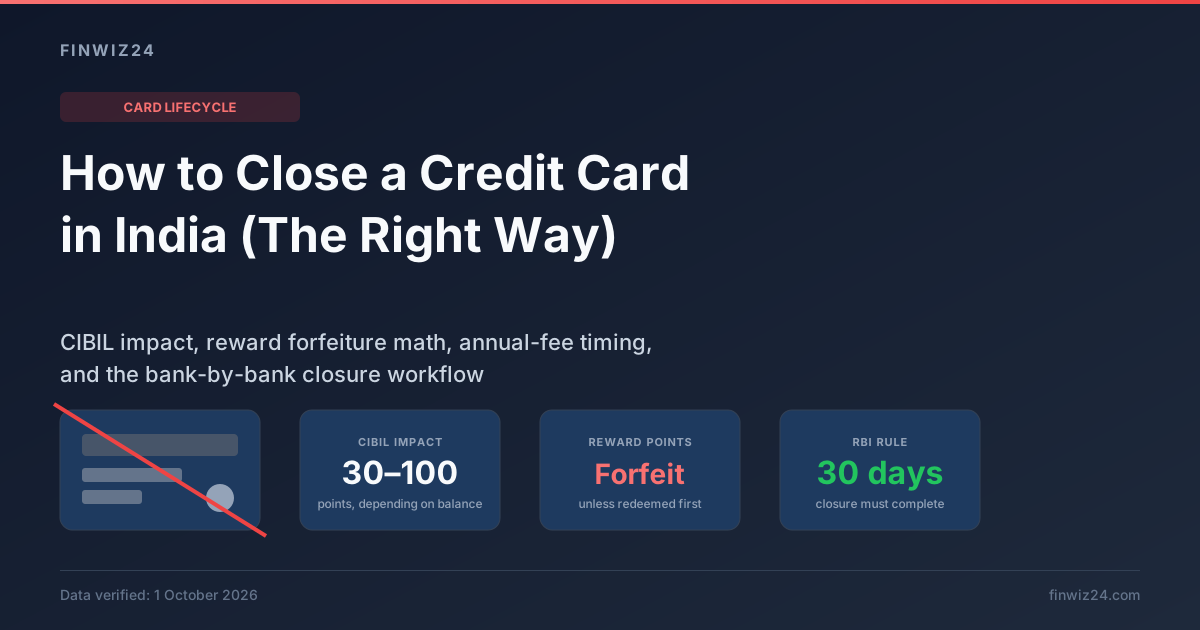
If you have a credit card you no longer use — the one with the ₹2,000 annual fee that no longer makes sense, or the airline miles card tied to a co-brand that quietly shut down — closing it is the obvious step. But the order in which you close it decides whether your CIBIL report loses 30–60 points or stays flat. It also decides whether you forfeit ₹5,000 in unredeemed reward points, get hit by a pro-rated renewal fee for the next billing cycle, or trigger a clawback of your welcome bonus.
The right way to close a credit card in India is sequential: clear the balance, redeem rewards, then close through the right channel with a written request. Skipping any one of those steps costs real money or real score. Below is the bank-by-bank process, the clawback math, and the CIBIL mechanics that determine whether closure is even the right move in your case.
Data verified: 1 October 2026, against the Reserve Bank of India’s Master Direction on Credit Cards and Debit Cards (2021, last amended 2024), public cardholder policies from HDFC Bank, ICICI Bank, SBI Card, and Axis Bank, and CIBIL’s reporting schedule for closed tradelines.
Decide first: should you close it, downgrade it, or hold it?
Before the closure workflow, run a three-question decision filter. The answer determines whether closing a credit card is the right move for you at all.
1. Is this your oldest active credit card?
If the card is your oldest credit account (often the one you opened at age 21 with a ₹25,000 limit), closing it shrinks your average account age, which is one of the top-weighted factors in your CIBIL score. CIBIL does not publish the exact weight, but bureau disclosures and lender guidance place it at roughly 15% of the score. The drop is most visible on thin files (people with three or fewer cards).
Practical rule: keep the oldest card active, even if you use it once every six months for a ₹100 recharge. If the card has no fee and the issuer is not actively soliciting its retirement, leave it open.
2. Will closure push your credit utilisation above 30%?
Your credit utilisation ratio (CUR) is the sum of balances across all credit cards divided by the sum of all credit limits. A consumer with two cards of ₹1,00,000 each and a ₹30,000 balance on one has a 15% CUR. Close the second card and the same ₹30,000 balance becomes a 30% CUR on a single ₹1,00,000 limit. That moves the cardholder from “excellent” to “borderline” in most lenders’ underwriting rubrics.
Practical rule: do not close any card if the resulting CUR exceeds 30%. Either pay the balance down first, or request a credit-limit increase on the card you are keeping so the new limit absorbs the lost limit.
3. Is the card’s annual fee a meaningful drag, or is it small relative to your spend?
A card with a ₹499 lifetime-free waiver above ₹1 lakh in retail is rarely worth closing because the waiver triggers automatically. A premium card with a ₹10,000 renewal fee that you will not hit the spend threshold for is a candidate — and downgrading to a lower-tier variant of the same family is often cheaper than closing. HDFC Bank’s Diners Club Black downgrade path to Millennia, for example, keeps the credit-history record intact while dropping the fee from ₹10,000 to ₹1,000.
If the answers are “1. No, I have older cards”, “2. No, my CUR stays below 30%”, and “3. Yes, the fee or the inactive card is costing me”, close it. Otherwise hold or downgrade.
The five-step closure workflow (applies to every Indian issuer)
The closure process below is the standard pattern that works against every major Indian card issuer: HDFC Bank, ICICI Bank, SBI Card, Axis Bank, Kotak Mahindra Bank, Standard Chartered, HSBC, RBL Bank, IDFC FIRST Bank, Federal Bank, Yes Bank, AU Small Finance Bank, and the American Express banking partners. Specific contact channels differ; the order of operations does not.
Step 1: Clear the balance to zero (and pay the next statement in full)
A card issuer will not act on a closure request while there is any outstanding balance — billed or unbilled. Pay the latest statement in full, redeem any pending cashback or reward points, and let one more statement close so the closure team can verify the account is at zero.
If you are carrying a revolving balance, paying it off in full before closure is the single biggest CIBIL-positive step you can take. A closed account with status “closed - paid as agreed” is materially better in the eyes of future lenders than an open account with a 15% revolving utilisation.
Step 2: Redeem all reward points, milestone vouchers, and lounge passes
Reward points are treated as a soft asset by every Indian issuer, and they almost always lapse on the date of account closure. The mechanics vary:
- Cashback cards (Amazon Pay ICICI, HDFC Millennia, SBI Cashback): Cashback is credited to the statement; balances below ₹1 typically stay in the account as a residual credit and are refunded to your bank account on closure.
- Reward-point cards (HDFC Diners Club Black, ICICI Sapphiro, Axis Atlas): Points must be redeemed through the issuer’s reward catalogue, transfer partners, or statement-credit option before the closure request is logged. Once the account is closed, the points are forfeited.
- Co-brand miles (Air India credit cards, Singapore Airlines KrisFlyer, Marriott Bonvoy): Miles linked to a partner programme can sometimes be transferred to the airline’s loyalty account before closure. Most issuers explicitly disclaim this in the Most Important Terms and Conditions (MITC) document.
A 5x-points-on-travel cardholder with ₹40,000 in unused points at a redemption value of ₹0.50 per point forfeits ₹20,000 on closure without a date. Check your issuer’s redemption portal before filing the closure request.
Step 3: Use or forfeit the next annual fee cycle
Most Indian cards renew the annual fee on the date of issuance, not the calendar date. SBI Card, for example, renews fees between 12 and 30 days before the membership anniversary. HDFC Bank typically renews within 7 days of the anniversary.
Two scenarios:
- If the renewal fee has already posted: Pay the fee, then close. Banks do not refund renewal fees on closure, except in retention-driven goodwill waivers (see Step 4).
- If the renewal fee is due in the next 30 days: Either request a fee waiver (most issuers grant one goodwill waiver every 12–24 months for active customers) or close the card before the renewal posts. Closing the card after the renewal date but before payment is not always possible — once the fee is posted to the statement, it is owed.
Practical rule: close the card 45 days before the membership anniversary if you have decided not to pay the renewal fee. That buffer ensures the closure request is logged before the fee posts.
Step 4: Try one retention call (optional, ~30% success rate)
Indian issuers’ retention teams have authority to waive renewal fees, downgrade cards, or offer fee-reversal vouchers as goodwill. The script that works:
“I am reviewing my credit-card portfolio. This card has a [₹X] renewal fee. I have used the card [N times] in the last 12 months. I would like to either downgrade the card or close it. Can you help me with a fee waiver to keep the card active?”
Expect a 20–35% success rate for cards that have shown transaction activity in the last six months, and a near-zero success rate for dormant cards (no transactions in 6+ months). The call typically takes 10–15 minutes, and the bank’s customer-care number routes you to the retention desk automatically for fee-related queries.
If the retention team offers a fee waiver, take it and skip Step 5. If they offer a downgrade (HDFC Diners Club Black → HDFC Millennia, for example), check the new card’s fee and rewards against your spend before accepting.
Step 5: Submit the closure request in writing (this is the legally binding step)
A phone request is not sufficient to close a credit card account. RBI’s Master Direction on Credit Cards and Debit Cards requires the card issuer to acknowledge a written closure request within seven days and complete the closure within 30 days. Without a written record, you have no proof of request date if the dispute ever escalates.
Channels that satisfy the “written” requirement:
- Email to the card issuer’s customer-care email address with your full name, last 4 digits of the card, and an explicit request to close the card. CC yourself. Save the acknowledgement email from the bank.
- Net banking or mobile-app closure request. Most issuers (HDFC Bank, ICICI Bank, SBI Card, Axis Bank) have a “Close Credit Card” workflow under card management. The on-screen confirmation page, with a timestamp, is the equivalent of a written request.
- Registered post (speed post or India Post registered mail) to the bank’s card operations address. This is the strongest evidence and is recommended for high-fee premium cards where any dispute is likely to be expensive. Keep the postal receipt and tracking number.
The closure request letter should include:
- Full name and date of birth as on the card.
- Last 4 digits of the card (never full PAN or full card number).
- Explicit instruction: “I request immediate closure of the above credit card. Please redeem all outstanding reward points and refund any residual balance to my registered bank account ending [XXXX].”
- A statement that no annual fee, late fee, or finance charge is outstanding on the account.
- Your signature (for physical letters) or full email thread with verified email address (for digital requests).
The bank must acknowledge within seven working days. If you do not receive an acknowledgement, escalate to the bank’s nodal officer (every bank must publish one on its website per RBI’s 2024 framework) and then to the RBI Banking Ombudsman if the nodal officer does not respond within 30 days.
Bank-by-bank closure channels (the verified email and inbox workflows)
Every Indian issuer has a slightly different path. Below are the documented closure channels for the four largest issuers plus the high-fee premium banks.
HDFC Bank credit cards
- Phone: HDFC PhoneBanking (1860-267-6161 from outside India, local city codes from within).
- Email:
[email protected](the published customer-services address for card products). - App: NetBanking → Cards → Service Requests → “Close Credit Card”. The confirmation page includes a service-request number; copy it.
- Postal: HDFC Bank Ltd, Card Operations, PO Box 10008, Mumbai 400021 (verify on the bank’s website before mailing — the address has changed in past years).
- Typical acknowledgement time: 7 working days. Closure completion: 30 days.
ICICI Bank credit cards
- Phone: ICICI Bank Customer Care (1860-120-7777 from outside India, 1800-200-3344 toll-free from within).
- Email:
[email protected]. - App: iMobile Pay → Cards → Manage → “Close Credit Card”.
- Postal: ICICI Bank Tower, Bandra Kurla Complex, Mumbai 400051 — addressed to the Card Services head.
- Important: ICICI Bank is the most common issuer to apply a closure fee on cards where the joining fee has been waived in the first 12 months. Check the most recent statement for a “card closure fee” line item of ₹1,000–₹3,000 before signing off on closure. This fee is contractual, but the bank’s customer-care team will waive it as a one-time goodwill on request.
SBI Card
- Phone: SBI Card Customer Care (1860-180-1290, 1800-180-1290, or +91 120 3938 98 90 for NRI).
- Email:
[email protected]. - App: SBI Card App → Services → “Close Credit Card”.
- Postal: SBI Card PO Box Address (varies by city; check the back of your statement for the correct address).
- Typical acknowledgement time: 7 working days. SBI Card sometimes asks for the physical card to be cut and returned by post. This is contractual for cards with a fee waiver condition in the first year.
Axis Bank credit cards
- Phone: Axis Bank Customer Care (1860-419-5555, 1800-419-0684 toll-free).
- Email:
[email protected]. - App: Axis Mobile → Cards → “Close Credit Card”.
- Postal: Axis Bank Card Operations, Axis House, C-2, Wagle Industrial Estate, Mumbai 400604.
- Note: Axis Bank is the issuer most likely to retain a small residual credit on the account after closure (often ₹1–₹50 from over-redemption or rounding). The bank refunds the residual to your registered bank account within 30 days of closure. Do not pad this with new spends after the closure request — they will not be honoured.
American Express (India) cards
- Phone: Amex India Customer Service (1800-180-1037 toll-free).
- App: Amex India App → Account → “Close Account”.
- Note: Amex Membership Rewards points can be transferred to airline partners (Singapore Airlines KrisFlyer, Etihad Guest, Air India Flying Returns, Marriott Bonvoy) before closure. Once the account is closed, the points are forfeited. This is the single largest preventable loss in the closure workflow.
Other issuers (Standard Chartered, HSBC, RBL, Kotak, IDFC FIRST, AU, Federal, DBS, IndusInd)
Every issuer maintains a documented closure channel on its website’s customer-care section. The pattern is identical: phone for triage, written request for legal effect, postal closure as the strongest evidence. The bank must honour the closure within 30 days under RBI rules.
What happens to your CIBIL report after closure
CIBIL’s reporting schedule for credit cards has three stages: open, closed, and dormant. The status you want on the closed account is “closed”, not “dormant” or “settled”.
- “Closed”: the bank closed the account on your request or as part of its own risk management. The tradeline continues to appear in your CIBIL report for up to 7 years from the closure date and contributes positively to your average account age.
- “Settled”: the bank wrote off a portion of the outstanding balance as a one-time settlement. This status is materially worse for your score than “closed” — avoid this at all costs and always close with a zero balance.
- “Dormant” or “Written Off”: the bank closed the account due to inactivity (dormant) or charged-off balance (written off). Dormant is rarely reported unless you specifically request closure; written off is a 24–36 month credit-score drag.
The CIBIL score impact of a voluntary “closed” tradeline depends on the age of the account at closure and the credit utilisation ratio of the remaining open cards.
Math: the CIBIL impact of closing a 4-year-old card
Consider a cardholder with two cards:
- Card A: ₹1,00,000 limit, opened 4 years ago, current balance ₹50,000.
- Card B: ₹50,000 limit, opened 1 year ago, current balance ₹0.
Total limit: ₹1,50,000. Total balance: ₹45,000. CUR: 30%.
The cardholder closes Card A on a zero balance.
After closure: Total limit ₹50,000. Total balance ₹45,000. CUR: 90%.
A 90% CUR will pull the score down by 50–80 points for most cardholders, in addition to the 10–25 point drop from the loss of average account age. The combined impact is 60–105 points — enough to push a 780 cardholder into the 700–720 range.
The right sequence is: pay the balance on Card A down first, then close. A 4-year-old cardholder who pays the ₹50,000 balance on Card A to zero before closure ends up with a 0% utilisation, then closes Card A. After closure: Total limit ₹50,000. Total balance ₹0. CUR: 0%. The CIBIL score on the remaining Card B improves by 10–30 points because the original 30% utilisation has dropped to zero, while the closed Card A’s contribution to account age persists in the report for up to 7 years.
The takeaway is mechanical, not financial. Always zero out the balance. Do not close a card that you have been revolving on.
What changes (and what does not) after closure
What does change
- Annual fee: No further renewal fees post the closure date.
- Reward points: Forfeited and unredeemable (unless transferred to a partner programme before closure).
- Lounge access and travel insurance: All current-cycle benefits end with the closure.
- Welcome benefit clawback: If the card has a conditional welcome benefit (e.g., “1,499 NeuCoins if you spend ₹10,000 within 30 days”), the issuer claws back the benefit in the closing statement. This is the issuer’s right under the MITC.
- Soft credit limit: If Card A is your highest-limit card, closing it can drop your “soft limit” — the unofficial aggregate limit the issuer uses across your other cards. Banks do not publish this, but lenders who see a closed high-limit tradeline may reduce unutilised headroom on your other credit lines by 10–30%.
What does not change
- CIBIL history: The closed account appears on your CIBIL report for up to 7 years from the closure date, contributing to average account age.
- CIBIL score: A voluntary closure on a zero balance has a 5–15 point impact (positive or negative) on the score, well within the score’s natural monthly volatility.
- Address and KYC: Your KYC documents stay valid for other financial products unless your PAN or Aadhaar is updated.
Frequently asked questions
How long does it take to close a credit card in India?
The bank must acknowledge your written closure request within 7 working days and execute the closure within 30 days under the RBI’s Master Direction on Credit Cards and Debit Cards. Most issuers close the account within 7–15 days of acknowledgement and refund any residual balance to your registered bank account in the next statement cycle.
Will closing a credit card hurt my CIBIL score?
Closing a card with a zero balance typically causes a 5–15 point change, well within the score’s normal monthly fluctuation. Closing a card with an outstanding balance is the worst-case move: it can drop the score by 50–100 points due to the credit utilisation jump on the remaining open cards. Always pay the balance to zero before filing the closure request.
Do I lose my reward points when I close a credit card?
Yes, in most cases. Reward points are tied to the account and are forfeited on the closure date. The exception is co-brand points (Amex Membership Rewards, Axis EDGE Miles, HDFC NeuCoins) that can be transferred to a partner programme (airline miles, hotel loyalty) before closure. Redeem or transfer points before filing the closure request to avoid forfeiting real value.
Can a bank refuse to close my credit card?
No. Under the RBI’s Master Direction, every Indian card issuer must honour a written closure request within 30 days. If the bank refuses, cite the specific clause of the Master Direction in writing to the bank’s nodal officer and, failing a response within 30 days, escalate to the RBI Banking Ombudsman. Closure is the cardholder’s right.
Will I get my annual fee back if I close within the first 30 days?
It depends on the card’s MITC. Most cards waive the joining fee (and refund it on closure within 30 days) but do not refund the renewal fee. Some premium cards (HDFC Infinia, ICICI Emeralde) have a 30-day unconditional refund window that covers both fees. Check the Most Important Terms and Conditions document for your specific card before relying on a refund.
What is the difference between a card closure and a card block?
A card block (also called hotlisting) is a temporary measure to stop a lost or stolen card from being charged. The account stays open, the credit history continues to accrue, and you can request a replacement card. Card closure is permanent: the account is closed, the credit limit is removed, and the closure is reported to the bureau. Closure is the right move when you no longer want the card; blocking is the right move when the card is lost or compromised.
Sources
- Reserve Bank of India — Master Direction on Credit Card and Debit Card Issuance and Conduct Directions (2021, last amended 2024) (verified 1 October 2026).
- Reserve Bank of India — Master Circular on Customer Service in Banks (2024 update) (verified 1 October 2026).
- CIBIL — Understanding Your Credit Information Report (verified 1 October 2026).
- HDFC Bank — Credit Card customer service and closure process (verified 1 October 2026).
- ICICI Bank — Credit Card closure workflow in iMobile Pay (verified 1 October 2026).
- SBI Card — Customer service channels and card closure request (verified 1 October 2026).
- Axis Bank — Credit card customer service and closure request channels (verified 1 October 2026).
Related reading
- Annual Fee Renewal: Should You Pay, Downgrade, or Cancel? — the decision framework for keeping, downgrading, or closing a card above a renewal fee.
- What a CIBIL Score Actually Is — and What It Isn’t — how CIBIL calculates the score, what moves it, and what does not.
- Credit Card Revolving Balance: The Real Interest Cost — why paying the balance to zero before closure matters for both your CIBIL report and your wallet.
- Credit Card Annual Fee Demystified — the breakdown of when an annual fee is worth paying and when it is not.
- HDFC Bank Credit Cards in India — full portfolio of active consumer cards from HDFC Bank.
- ICICI Bank Credit Cards in India — full portfolio of active consumer cards from ICICI Bank.
- Annual Fee Break-Even Calculator — calculate the spend required to recover the annual fee before deciding to keep or close a card.
- Lifetime Savings Calculator — model the multi-year net value of keeping a card before committing to the renewal fee.