Blog
RBI BBPS Credit Card Bill Payment: Rules, Timelines, and Fees

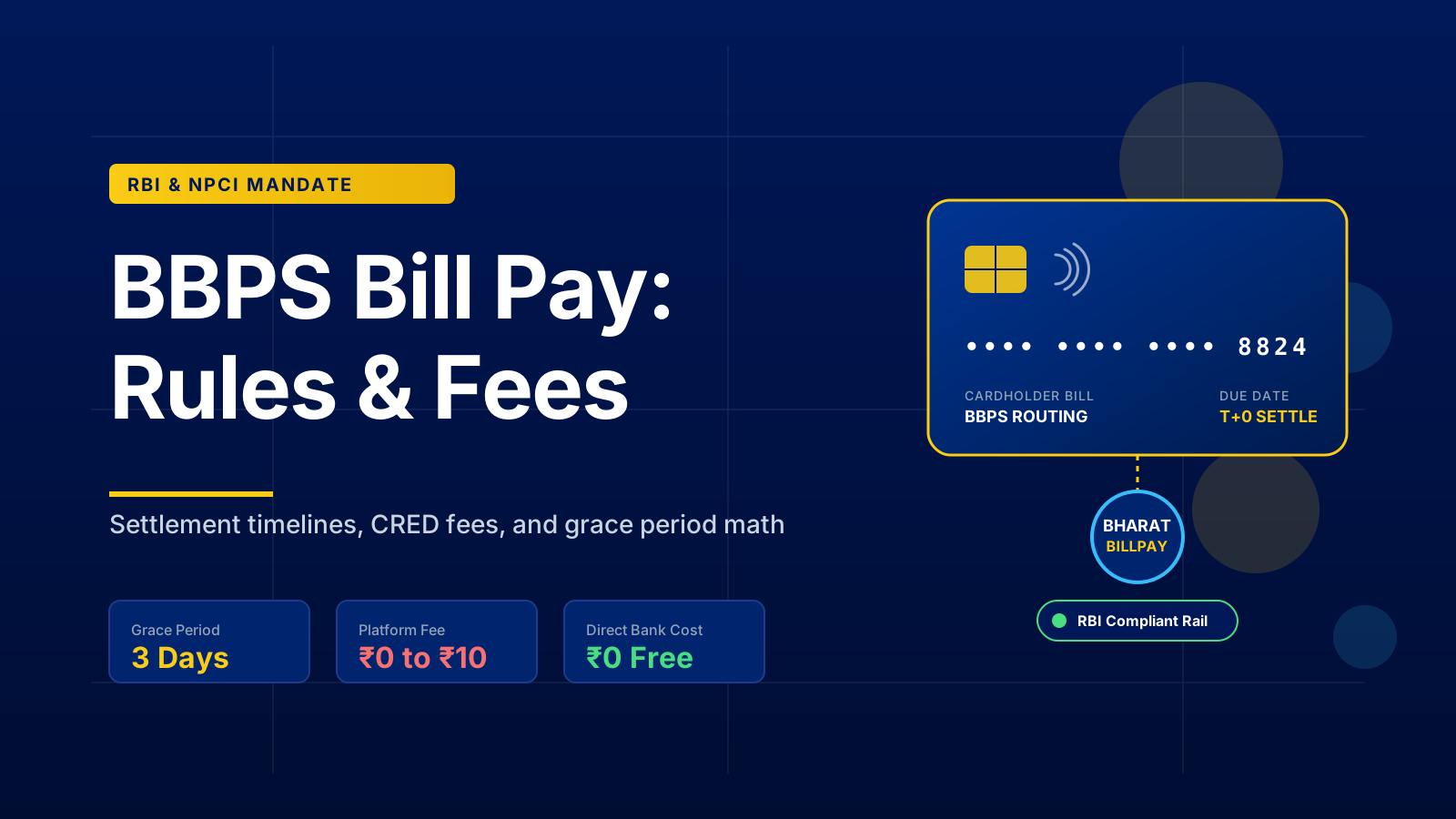
You must pay your credit card bill through the Bharat Bill Payment System if you use third-party apps like CRED, PhonePe, or Paytm. The Reserve Bank of India set this rule to protect cardholders from lost payments and settlement disputes. BBPS gives you a standard tracking ID and quick digital receipts. But third-party apps now charge platform fees of ₹1 to ₹10 per bill payment. If you want zero fees and fast credit, your bank app or auto-debit is the best choice.
The short answer
The Reserve Bank of India set clear rules for card bill payments. All third-party apps must route credit card bills through the Bharat Bill Payment System. The network is run by NPCI Bharat BillPay Limited. Apps can no longer use private payment loops to clear your dues.
When you pay on CRED, PhonePe, or Paytm, your money moves through this central rail. Major card issuers like SBI Card, HDFC Bank, ICICI Bank, and Axis Bank now support this system. You get a single reference number for each payment.
Data verified: 20 October 2026, against the RBI Master Direction on Credit Card Conduct and NPCI Bharat BillPay operating guidelines.
Why the RBI made BBPS mandatory for credit card bills
Before this rule, third-party apps used custom payment routes. Some apps held user money in pool accounts. Then they sent batch payments to banks through NEFT or IMPS. This created three big risks for cardholders.
First, payments made on the due date often took 24 to 48 hours to clear. This caused unfair late fees. Second, failed payments were hard to trace. Banks and apps blamed each other when money went missing. Third, users had no central place to file disputes.
The BBPS mandate standardizes all credit card bill settlements across India:
- Central clearing: All bill transactions pass through NPCI Bharat BillPay Limited.
- Instant reference ID: Every bill payment receives a verified tracking number recognized by both the app and your bank.
- Standard dispute redressal: If a payment stalls, banks and payment aggregators must resolve it within defined turn-around times.
- Direct bank acknowledgement: Issuing banks acknowledge payment receipt in real time rather than waiting for next-day file reconciliations.
Processing timelines: how fast does your money clear?
Processing speed depends on the channel you choose. While BBPS operates 24 hours a day, the time it takes for your available credit limit to update varies by bank:
| Payment Method | Settlement Speed | Credit Limit Update | Due Date Safety | Platform Fee |
|---|---|---|---|---|
| Bank Mobile App / NetBanking | Real-time (instant) | Instant | Highest (safe on due date) | ₹0 (Free) |
| Bank Standing Instruction / Auto-Debit | Scheduled on due date | Same-day | Highest (automated) | ₹0 (Free) |
| BBPS via Third-Party UPI (CRED, PhonePe) | Near real-time (T+0) | 15 mins to 3 hours | Moderate (pay 1 day early) | ₹0 to ₹5 |
| BBPS via Debit Card on Third-Party Apps | T+0 to T+1 business day | Up to 24 hours | Low (risk of bank cut-off) | 1% to 1.5% + GST |
| Direct IMPS / NEFT from Non-Card Bank | 30 mins to 4 hours | 2 to 6 hours | Moderate (avoid late night) | ₹0 (most banks) |
Even on BBPS, do not wait until 11:45 PM on your due date to pay your bill. If your bank runs scheduled nightly maintenance on its core banking servers, the payment authorization may log after midnight. To stay safe, pay at least one business day before the statement due date.
The RBI 3-day grace period: your legal buffer
Under the RBI Master Direction on Credit Card and Debit Card Issuance (RBI/2022-23/92), cardholders have an important legal safeguard. Banks cannot charge a late payment fee on the exact due date.
Issuers must grant a 3-day grace period after the due date before imposing any penalties:
“For the purpose of reporting to Credit Information Companies and levying penal charges, banks shall consider the cardholder as defaulter only if the account remains overdue for a period exceeding three days from the due date.”
The math of missing the grace period
If your payment arrives within three days of the due date, the bank cannot charge a late fee. The bank also cannot report a default to credit bureaus like CIBIL. But if your payment clears after that 3-day buffer, the penalties are severe:
- Late Payment Charge: For statement balances above ₹50,000, banks charge up to ₹1,300 per cycle.
- GST on Penalties: Late fees attract 18% GST, adding ₹234 to the fee for a total of ₹1,534.
- Finance Charges (Interest): The bank charges interest of 3.50% to 3.75% per month (42% to 45% APR) calculated from the original transaction date, not the bill due date.
- Loss of Interest-Free Period: All new purchases lose their interest-free period until the entire outstanding balance is paid in full.
For a detailed analysis of grace period rules, read our guide on RBI 3-Day Grace Period Rules.
The end of free rewards: platform convenience fees explained
For years, fintech apps gave cash rewards and coins for bill payments. Today, that model has ended. Most apps now charge platform convenience fees to cover operating costs.
Users pay ₹1 to ₹5 on standard UPI bill payments. Debit card payments on third-party apps can cost 1.0% to 1.5% plus 18% GST.
Show the math: convenience fees vs reward value
Let us calculate the true rupee cost of paying bills on third-party apps versus direct bank channels:
- Annual convenience fees: If you pay 3 credit card bills a month, that is 36 transactions a year. At a flat ₹3 convenience fee per bill, you pay ₹108 annually just to settle your own bills.
- Debit card surcharge cost: If you pay a ₹40,000 credit card bill using a debit card on a platform charging a 1% fee, the surcharge is ₹400 plus 18% GST (₹72). You lose ₹472 on a single payment.
- App reward coin value: Earning 10,000 coins on a bill payment app typically redeems for ₹0.20 to ₹0.50 in tangible cash or coupon discounts.
- Net value calculation: ₹0.50 in app rewards minus ₹3.00 platform fee equals a net loss of ₹2.50 per payment.
Paying your credit card bill on third-party apps for reward points is no longer profitable. You lose money on every transaction where a platform fee applies.
Comparing bill payment methods
Every bill payment route offers distinct trade-offs between speed, cost, and convenience:
1. Bank Mobile App or NetBanking (Recommended)
Paying directly through your card issuer’s official app (such as HDFC MyCards, ICICI iMobile, or SBI Card) carries zero convenience fees. The payment posts immediately, and your credit limit restores within seconds.
- Best for: Instant credit limit clearance and guaranteed ₹0 fees.
2. Standing Instruction / Auto-Debit
You can set up an auto-debit mandate directly from your savings account to pay the total amount due on each due date.
- Best for: Cardholders who never want to track calendar due dates or risk late payment penalties.
3. BBPS via Third-Party Apps (CRED, PhonePe, Paytm)
Useful if you hold cards from five different banks and want a unified dashboard showing all statement balances in one place.
- Best for: Centralized bill tracking across multiple banks, provided you use free UPI rails and pay at least three days ahead.
To evaluate overall borrowing costs or balance conversion terms, use our free EMI Calculator or Credit Card Interest Calculator, and explore all tools on our Financial Calculators Hub.
Step-by-step: how to avoid credit card bill fees
Follow these five practical rules to avoid platform fees and late charges:
- Set up auto-debit for the total amount due: Link your primary savings account to pay the full statement balance automatically. This avoids both interest charges and late fees.
- Pay three business days early when using third-party apps: If you prefer paying through an aggregator app, initiate your payment 72 hours before the due date to protect against network delays.
- Check the payment review screen for platform charges: Review the transaction summary before entering your UPI PIN. If the app shows a convenience fee, switch to your bank’s mobile application.
- Never pay credit card bills via debit card on surcharge platforms: Avoid paying a 1% to 1.5% surcharge on debit card bill payments. Use direct UPI or NetBanking instead.
- Keep your BBPS transaction reference ID: Take a screenshot of the confirmation screen containing the BBPS reference number until your bank sends statement confirmation.
If you ever encounter an incorrect charge or payment mismatch, review our guide on Credit Card Billing Disputes in India and our Editorial Review Methodology.
Frequently asked questions
What is BBPS in credit card bill payment?
BBPS stands for Bharat Bill Payment System. It is an interoperable bill payment network managed by NPCI Bharat BillPay Limited under RBI regulations. It centralizes credit card bill payments, ensuring standardized settlement timelines and verified transaction tracking across all banks and apps.
Can I pay my credit card bill on the due date via BBPS?
Yes, but it is safer to pay earlier. BBPS processes transactions in real time or near real-time. However, bank backend servers may take several hours to update your account balance. If you pay late at night on your due date, server maintenance could push payment settlement past the deadline.
Why do apps like CRED and PhonePe charge platform fees?
Third-party fintech apps introduced platform convenience fees of ₹1 to ₹10 to cover payment infrastructure costs, gateway charges, and SMS routing expenses. These fees offset operational expenses as venture capital subsidies on payment processing have decreased.
How does the RBI 3-day grace period protect cardholders?
Under the RBI Master Direction, credit card issuers cannot levy late payment charges or report an account as overdue to credit bureaus like CIBIL unless the bill remains unpaid for more than three days after the official due date.
What should I do if my BBPS bill payment fails?
If money is deducted from your bank account but your credit card balance does not update, save the BBPS reference ID. Per RBI guidelines, failed transactions must be reversed to the originating bank account within T+1 to T+2 business days. If the funds are not returned, raise a complaint directly through your payment app citing the BBPS transaction number.
Sources
- Reserve Bank of India (RBI): Master Direction – Credit Card and Debit Card – Issuance and Conduct Directions, 2022 (verified 2026-10-20)
- NPCI Bharat BillPay Limited: Bharat BillPay Operating Guidelines and Participant Circulars (verified 2026-10-20)
- HDFC Bank: Credit Card Schedule of Charges and Bill Payment Terms (verified 2026-10-20)
- SBI Card: Most Important Terms and Conditions (MITC) and Late Payment Schedule (verified 2026-10-20)